
The SIM for Thing Portal is a self-service platform. In order to us the portal optimally, you can find a description of the elements used within the portal and their interdependence.
Since February 2025 there is a new home menu added a landing page to SIM for Things. See Home for more information.

ENDPOINT
-
The endpoint is a virtual representation of the end user device (IoT device, M2M device, …) and needs the following elements to be linked to it:
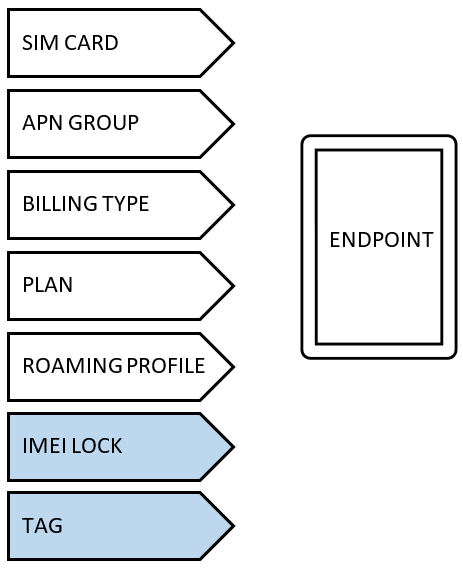
SIM Card
The SIM card need to be linked to an endpoint in a one to one relation. Meaning that a SIM can only be linked to one endpoint and an endpoint can only be linked to one SIM.
APN Group
This defines a set of allowed APN’s for a specific endpoint. By default the BICS APN will be available (bicsapn) that grants access to the public internet. You can also get access to the America and Asia regional APN’s or request a private APN to route your device traffic directly to your data centre and when you do not want the data to go over the public internet. You could also request a APN with your brand name for marketing reasons. See the https://bics-iot.atlassian.net/wiki/spaces/SFTTM/pages/1270710276 chapter for more information.
Billing Type
You can define the billing type for each endpoint. The billing type can be postpaid or prepaid.
The postpaid or prepaid billing type for your endpoint is independent from the commercial agreement between BICS and the enterprise.
- If the endpoint is defined as a prepaid billing type: every individual endpoint will have its own balance and the consumption will be deducted from it. if the balance reached zero for that endpoint, the the service will be blocked for that endpoint. when creating a prepaid endpoint, the available balance is set to zero. in order for the endpoint to use any data or SMS service, the balance will have to be topped up
- If the endpoint is defined as a postpaid billing type: the consumption made by the endpoint will be accumulated over the month and will automatically reset at the end of the month.
Plan
Each endpoint will have to have an associated plan. You can create as many plans as you want and link the same plan to several endpoints. The plan depends on the billing type! You will have to create one plan for postpaid and one for prepaid. See next section for more details.
Roaming Profile
The roaming profile managed the endpoint coverage. The roaming profile contains a set of mobile operators, visited networks in the different countries where you want to allow the endpoint to connect to. This allow you to control where the endpoint(s) can use the service.
IMEI Lock (optional)
The International Mobile Equipment Identity (IMEI) is a unique identifier of a device that is provided by the device manufacturer. Every (IoT) device has a unique IMEI (15 decimal digits). Via the IMEI lock we can make sure that the SIM will only work with that device. If someone steals the SIM and puts it into another device, then the system will prevent the SIM to do data services.
TAG (optional)
With TAGS you can group your endpoints. An endpoint can have up to 10 TAG’s linked to it. You can create up to 1000 TAG’s per account.
PLAN
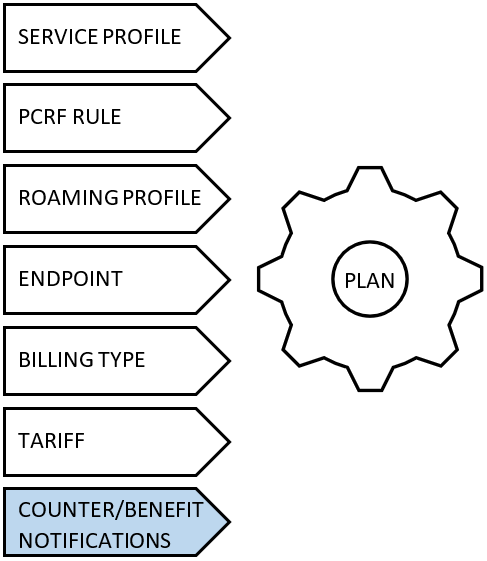
Service profile
The service profile must be linked to the plan and will define the radio access type (2G, 3G, 4G, LTE-M, NB-IoT) - (Data and or SMS) that can be used by the endpoint.
PCRF Rule for Throttling
The Policy and Charging Rules Function (PCRF) will allow if needed to throttle the data consumption of the endpoint.
Roaming profile.
The roaming profile will also be assigned the plan (and endpoint). If you define several roaming profiles in a plan, you can at endpoint level activate or disable one roaming profile for a particular endpoint.
Endpoint
See above.
Billing type
The billing type can be postpaid or prepaid.
Tariff
The parent (BICS or reseller account) that created the Tariff will also be set as default for the endpoints. The tarif is defined per service (Data, SMS) and per Rate zone (group of operators grouped per country or regions - example define a price for data for all mobile operators belonging to the EU27 region).
Counter, Benefit and Notifications (optional)
The counter, benefits and notifications are optional parameters that can be set at the plan level. The notifications can be send to an endpoint or external source based on predefined triggers like monthly consumption reached. We can also add benefits to the plan, which are a one time package of data or SMS that will be available to the endpoint. With the counters you can for a predefined duration control the actual usage of the endpoint and define actions to be taken if the volume reached that limit during the predefined time window. those actions could be to temporary blocked from the service or reduce the throughput (throttle).